

Small homes can still give children a place that feels playful, comfortable, and easy to use. Good Apartment kids playroom Decor does not depend on a spare room, expensive furniture, or permanent renovations. It depends on planning the floor carefully, choosing storage children can reach, and making every item earn its space. Corners of living rooms, wide hallways, dining-room edges, and bedroom walls can all become useful play areas. The following ideas focus on realistic apartment limits, including tight layouts, shared rooms, rental rules, noise, clutter, and changing needs as children grow.
Many parents buy colorful accessories first, then try to fit storage around them. Reverse that order. Plan movement, storage, lighting, and safety before adding color. Children need open floor space to build, draw, or spread out a puzzle. Adults need clear walkways, easy cleanup, and furniture that does not crowd the apartment. Thoughtful choices can support both needs without turning the whole home into a toy room.
Can a small apartment play area feel organized and special without taking over the living room?
Yes. Apartment kids playroom Decor works best when the space has clear boundaries, low storage, flexible furniture, and a limited color plan. Even six to eight feet of wall space can support books, toys, art supplies, and a small activity table. Use one rug to mark the zone, keep frequently used items at child height, and store occasional toys higher up. When the play area has a defined purpose, it feels intentional instead of temporary or messy.
Define the Play Zone With the Right Rug
Floor boundaries help children understand where play begins and where household walkways must remain clear. Choose a low-pile rug that sits fully under the main play area rather than floating beneath one small table. Sizes such as 5 by 7 feet or 6 by 9 feet work well in many apartments, but measure doors, heating vents, and furniture legs first. Leave at least 24 inches for a main path whenever possible. One visual island feels calmer than several disconnected toy piles.
Washable flat-weave rugs suit families dealing with snacks, paint, pets, or frequent spills. Soft cream, muted blue, sage, sand, or warm gray can support colorful toys without making the room feel busy. Skip thick shag because small pieces disappear inside it and wheeled toys move poorly across the surface. Best results come for renters who need a removable way to divide a shared living room. Add a nonslip pad cut slightly smaller than the rug, especially on vinyl, laminate, or polished wood floors.
Choose Low Modular Storage Children Can Use

Low storage encourages children to put things away because they can see and reach each category. Look for cube units, open shelves, or modular bins between 24 and 32 inches high. Secure any freestanding unit according to the manufacturer’s instructions, especially when drawers or climbing temptations are present. Place heavier toys near the bottom and lighter baskets higher. Four to six categories usually work better than twelve tiny labels. Blocks, vehicles, pretend play, puzzles, art supplies, and soft toys cover most everyday needs.
Open baskets reduce cleanup friction, while clear lidded boxes suit small pieces that need dust protection. Woven polypropylene, canvas, and smooth plastic are easier to clean than deep natural-fiber baskets. Pick two matching basket colors and repeat them across the unit for a quieter appearance. Families with toddlers benefit most because pictures can replace written labels. Photograph the contents, print small cards, and attach them with removable hook-and-loop dots. Children can match each toy to its picture without needing constant adult direction.
Install Slim Book Ledges Instead of a Bookcase

Front-facing books invite children to browse because covers are easier to recognize than narrow spines. Slim picture ledges also use wall depth more efficiently than a traditional bookcase, which can project 10 to 14 inches into the room. Mount two or three ledges with enough space for tall picture books, then keep the lowest shelf within comfortable reach. Renters should ask permission before drilling or use a freestanding front-facing book rack when wall fixing is not allowed.
Rotation keeps the display useful. Show eight to twelve books and store the rest in a lidded bin or higher cabinet. Change the selection every few weeks to match seasons or current interests. Soft wood, white, or wall-matched ledges let covers stand out without adding visual noise. Book ledges suit narrow corners, dining nooks, or a wall beside a child’s bed.
Add a Foldable Table for Art and Building
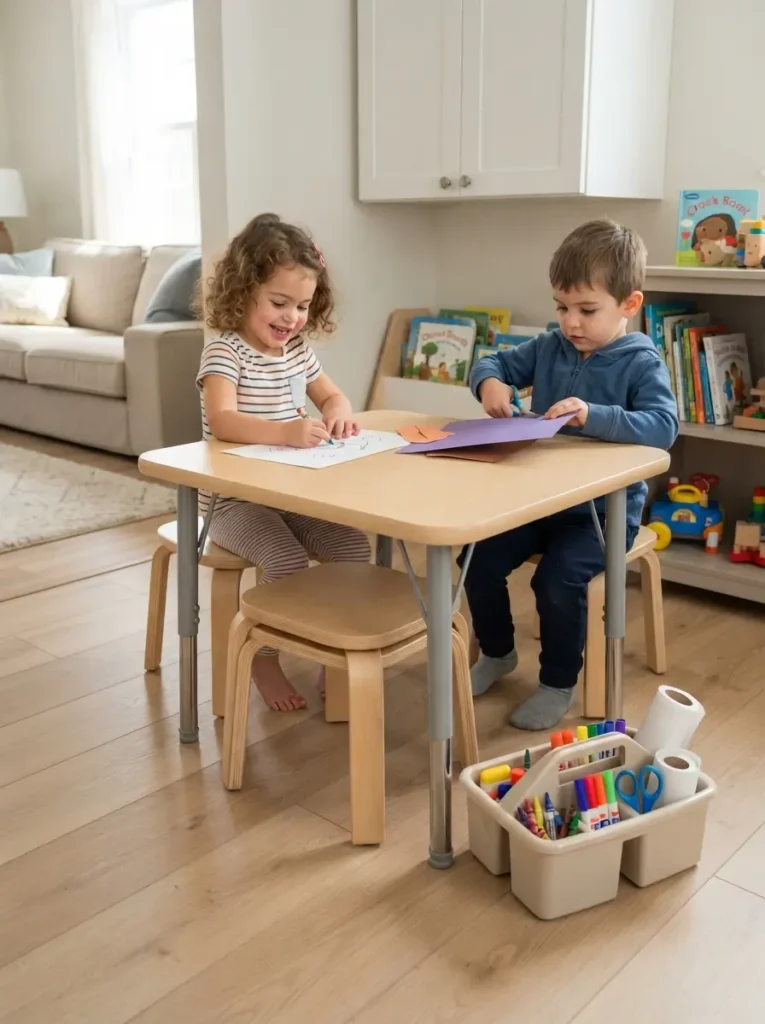
Flexible furniture allows one small zone to support several activities. Choose a wall-mounted drop-leaf table, a lightweight folding table, or a nesting table set that can disappear when floor play matters more. A tabletop around 20 to 24 inches high suits many preschool children, while adjustable legs extend the furniture’s useful life. Rounded corners reduce bumps in narrow rooms. Keep the table close to washable flooring when possible, because paint, glue, and snack crumbs are harder to manage on carpet.
Store only daily supplies beside the table. One handled caddy can hold crayons, washable markers, child-safe scissors, glue sticks, and a small roll of paper. Extra craft materials belong in a closed upper cabinet. Such editing prevents the work surface from becoming permanent storage. Best for families who use the dining table for meals and homework, a compact activity table gives children a predictable place to create. Pair it with stackable stools that slide underneath and can double as side tables.
Build a Calm Color Palette Around the Toys

Toys already bring strong red, yellow, blue, pink, and green into a room, so large surfaces rarely need equally intense color. Start with a warm neutral base such as soft white, oatmeal, pale taupe, or light greige. Add one gentle supporting color, then repeat it across the rug, bins, cushions, and small art details. Sage with warm cream feels grounded, dusty blue with pale oak feels fresh, and muted terracotta with beige brings warmth without overwhelming a compact room.
Repeated tones help useful objects stand apart from background clutter. Keep the largest furniture close to the wall color so its edges look less dominant. Use brighter shades on cushions, prints, baskets, and bunting. Beginners can follow a loose 70-20-10 balance: 70 percent neutral, 20 percent supporting color, and 10 percent lively accents. Treat those numbers as guidance, not a strict rule.
Use Vertical Space Without Making It Feel Heavy
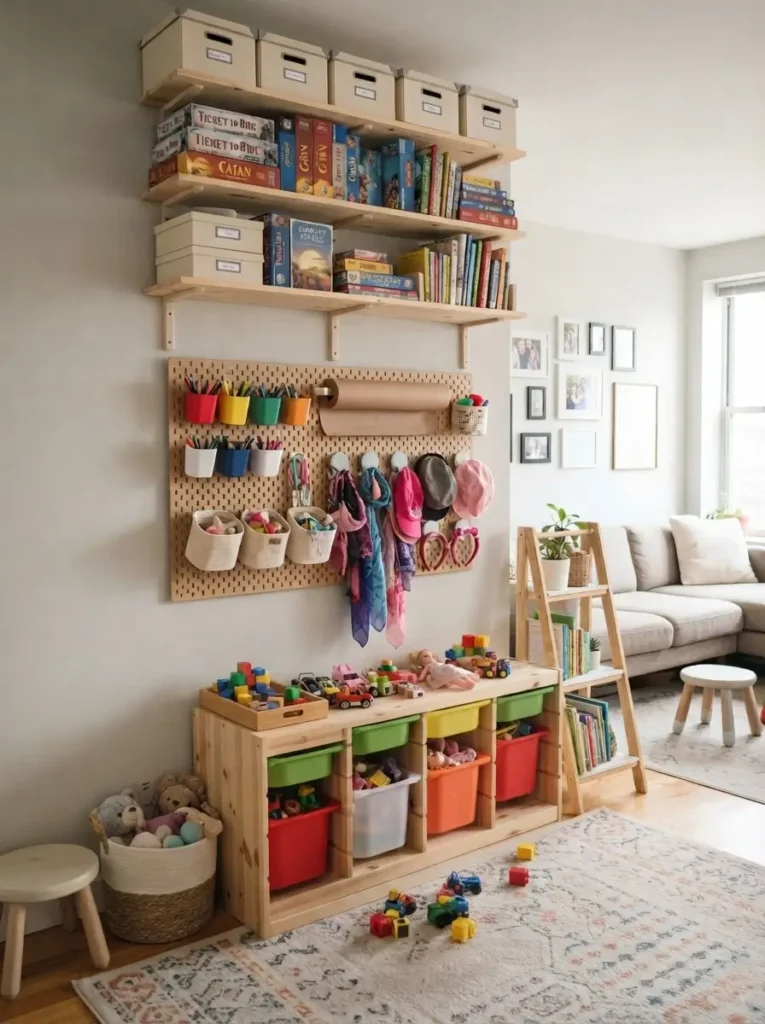
Walls can handle supplies that do not need to occupy the floor. Install narrow shelves above adult shoulder height for boxed games, rotated toys, keepsakes, and backup craft materials. Keep daily play items lower so children do not climb to reach them. Pegboards can hold lightweight cups, paper rolls, dress-up accessories, and small baskets, but every hook should sit securely and avoid sharp exposed ends. Match the pegboard to the wall color when you want it to blend into a shared room.
Vertical storage works especially well in studio apartments and one-bedroom homes where every square foot has another job. Leave some wall area empty rather than covering the entire surface from floor to ceiling. Negative space helps the play zone feel considered and prevents shelves from looming over children. Rental-friendly options include tension-pole organizers, over-door fabric pockets, and freestanding ladder shelves with broad stable bases. Avoid placing heavy objects above seating or active play areas, even when the shelf itself appears secure.
Create a Reading Corner With Floor-Level Comfort
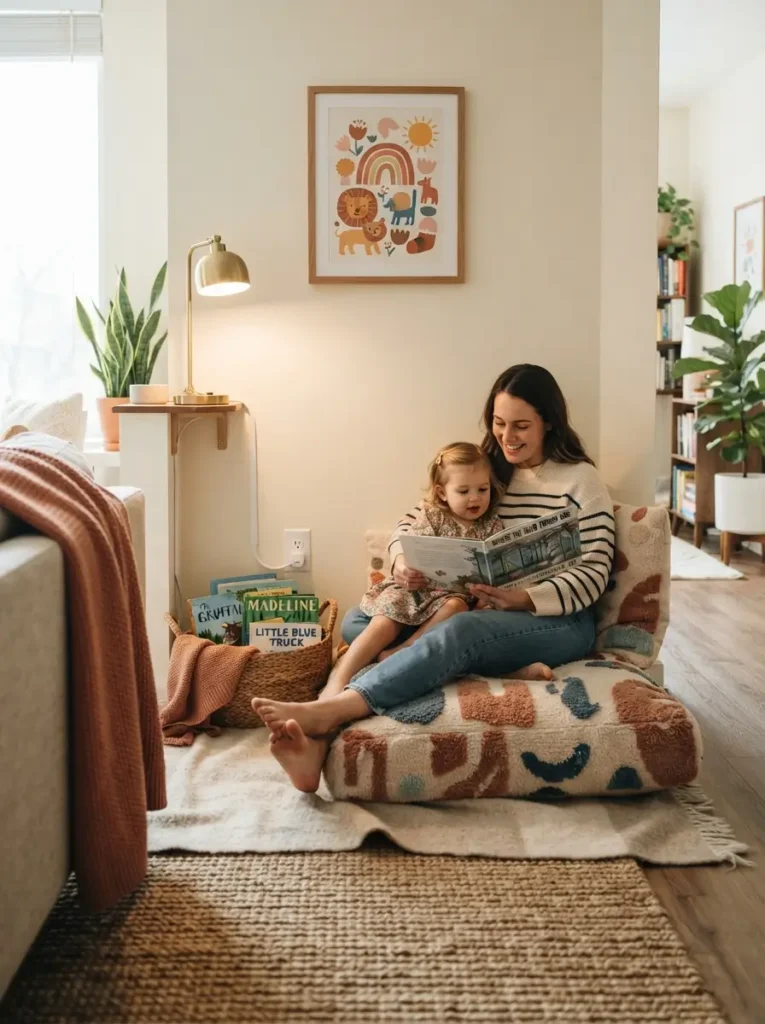
Reading nooks need comfort, good light, and enough support for an adult to join. One washable floor cushion, a small back pillow, and a basket of books can be more practical than a miniature chair children quickly outgrow. Position the nook against a wall or in a corner so cushions stay contained. Keep at least one nearby outlet inaccessible to small hands and route lamp cords behind furniture or through a cord cover.
Layering soft materials makes a hard apartment corner feel welcoming without consuming much floor area. Choose cushion covers with zippers so they can be washed, and avoid large piles that collect dust or block walkways. Families with children who need quiet breaks benefit from a nook that feels separate from louder building toys. Place a soft throw in a reachable basket and add one simple wall print. Inspiration can come from Retro Apartment Wall Art, but choose child-friendly shapes and colors rather than fragile framed pieces.
Layer Warm Lighting for Play and Quiet Time
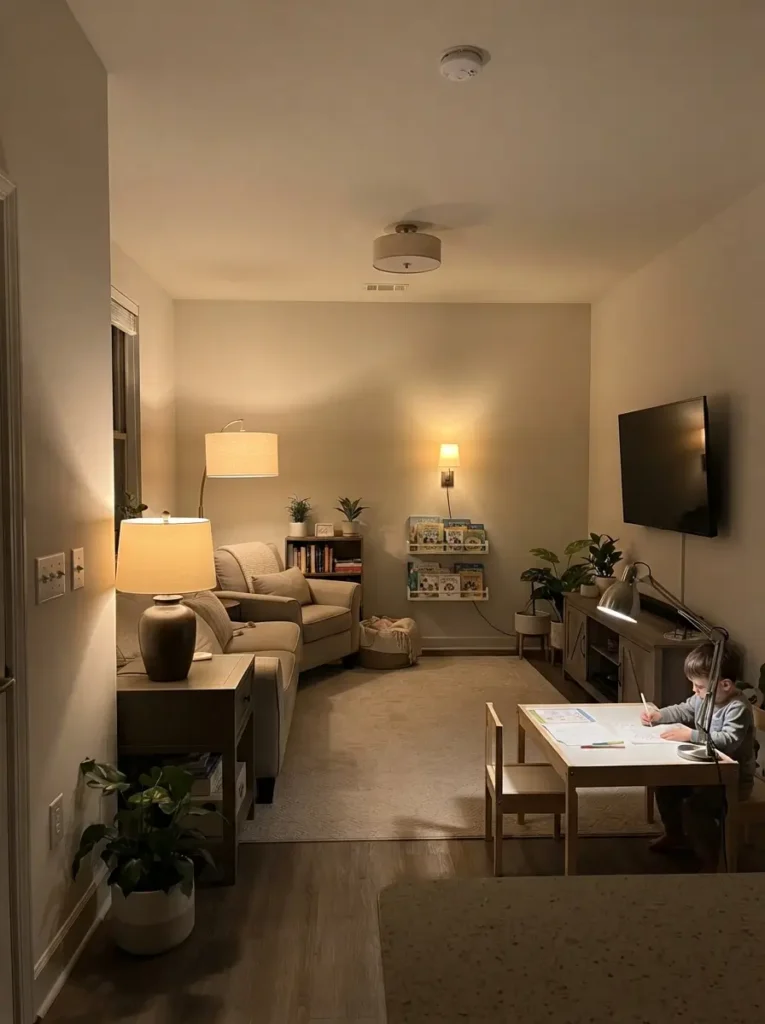
Overhead lighting alone often creates harsh shadows, especially in apartments with one central ceiling fixture. Combine general light with a shaded floor lamp, wall-mounted plug-in sconce, or sturdy table lamp placed beyond a child’s reach. Warm white bulbs around 2700K to 3000K support reading and evening play without feeling clinical. For drawing or detailed building, a focused task lamp around 3000K to 3500K can improve visibility while still feeling comfortable.
Good lighting supports different moods without extra decoration. Use dimmable bulbs when possible, lowering them before bedtime or quiet activities. Check that lamps cannot tip and cords cannot form loops. Renters can choose plug-in sconces with cord covers. Shared rooms may already include Living Room TV Wall Designs, so position play lighting to reduce screen glare and harsh reflections.
Display Children’s Art With Removable Systems
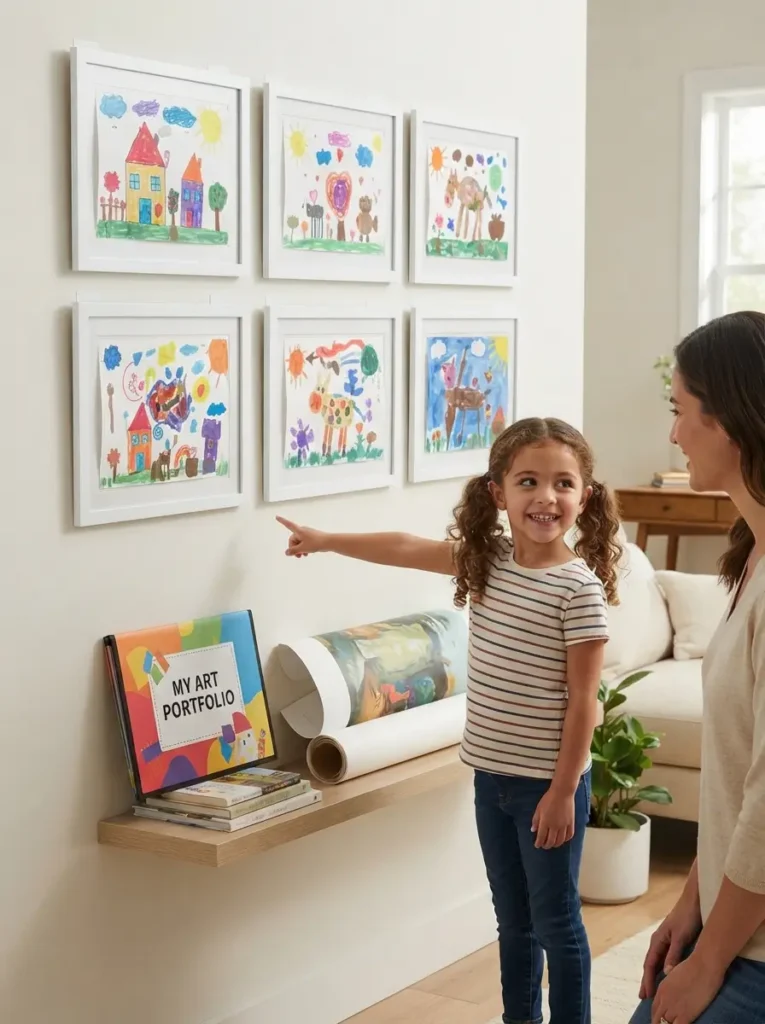
Children value seeing their work treated with care, yet permanent gallery walls can quickly become crowded. Use removable picture strips, magnetic poster rails, clipboards, or a wire display fixed securely to create one controlled art area. Limit the display to four or six pieces, depending on wall width. Store older favorites in a portfolio folder and photograph oversized projects before recycling them. Regular editing gives every new piece a chance to stand out.
Consistent frames or matching clips make varied artwork feel connected. White, pale wood, or black frames can work, but lightweight acrylic fronts are safer than glass in active areas. Best for renters, removable strips allow the display to move without leaving many holes, although wall finish and product instructions should always be checked first. Set the display at a child-friendly viewing height rather than near the ceiling. Children can then discuss their work, choose replacements, and take part in refreshing the room.
Use a Storage Bench as Seating and a Divider

Compact storage benches can hold dress-up clothes, large blocks, train sets, or stuffed animals while also giving adults a place to sit. Choose a model with slow-close hinges, open cubbies, or pullout bins to reduce pinched fingers. Depths between 14 and 18 inches usually provide useful storage without projecting too far into a narrow room. Place the bench against a wall for stability or use a low open unit to divide a play corner from a dining space.
Dual-purpose furniture earns its place because apartments cannot always support separate seating and storage. Add one fitted cushion with a removable washable cover rather than several loose pillows. Keep the top clear enough for actual sitting. Households with mixed-age children benefit when adults can supervise comfortably while younger children play. Measure nearby doors and drawers before buying, because a bench that blocks a cabinet by two inches will become frustrating. Painter’s tape on the floor can help test the footprint before purchase.
Make Pretend Play Easy to Pack Away

Large toy kitchens and permanent playhouses can dominate a small apartment. Build a portable pretend-play kit instead. One lidded box can hold fabric food, wooden dishes, a doctor set, scarves, puppets, or shop signs. Use the side of a low cabinet as a temporary counter, then return everything to the box after play. A fabric door curtain can become a shopfront or theater when attached with removable hooks and folded away afterward.
Portable setups protect open floor space while still supporting imaginative play. Rotate one theme at a time so children have enough materials to build a story without emptying every container. Best for families who share the room throughout the day, pack-away play can transform a living area in minutes. Choose props with more than one use, such as plain scarves that become capes, picnic blankets, costumes, or scenery. Avoid highly specific plastic sets that take up space but support only one narrow activity.
Add a Removable Drawing or Learning Surface
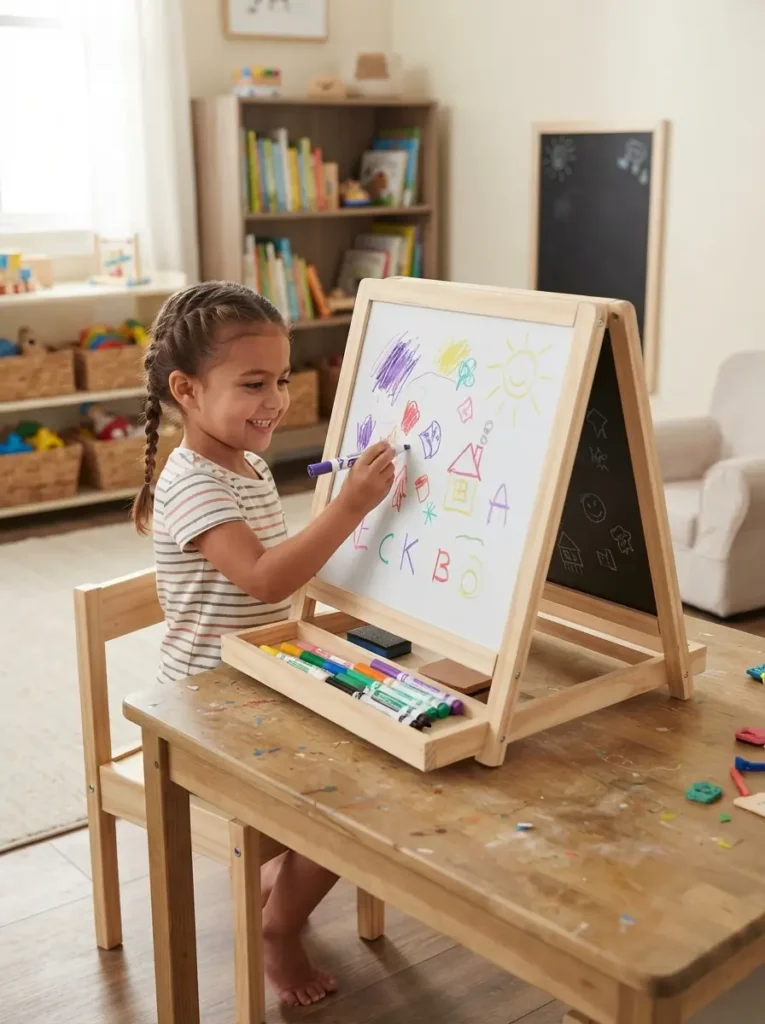
Reusable drawing surfaces reduce loose paper and give children a clear place to make marks. Peel-and-stick whiteboard sheets, removable chalkboard panels, or a portable easel can fit behind a door or beside a craft table. Test adhesive products in a hidden spot because some rental paint lifts easily. Keep the drawing surface away from upholstered furniture and provide washable markers or low-dust chalk. A shallow tray or hanging cup prevents supplies from scattering across the floor.
Learning surfaces work because they change with the child. Toddlers can scribble, preschoolers can practice shapes, and older children can make lists or solve homework problems. Families with limited wall space may prefer a double-sided tabletop easel that folds flat. Use nearby lighting strong enough to prevent shadows from the child’s hand. Keep decorative writing minimal and leave most of the surface open. Function should lead the design, especially in rooms where every visual element competes for attention.
Rotate Toys Instead of Displaying Everything

Toy rotation creates breathing room without requiring children to own fewer interests. Divide toys into three or four groups, leaving one group available and storing the rest in labeled containers. Rotate based on use rather than a fixed calendar. Some families change boxes every two weeks, while others wait until engagement drops. Keep favorite comfort toys accessible all the time. Puzzles and sets should remain complete before storage so their return feels inviting rather than frustrating.
Fewer visible choices can support deeper play and faster cleanup. Rotation also reveals ignored, duplicated, or outgrown toys. Use high safe shelves, under-bed boxes, or a hall closet for off-duty items. Keep a phone note listing each box so nothing gets forgotten or purchased twice.
Choose Finishes That Belong in the Whole Apartment

Shared rooms look more settled when playroom furniture relates to the rest of the home. Pale oak, walnut, matte white, warm gray, or simple black accents can connect children’s storage with nearby adult furniture. Child-friendly does not require cartoon shapes on every surface. Let toys, books, and art provide personality while permanent pieces remain adaptable. Rounded wood tables, plain cube storage, and woven-look washable bins can continue working as children grow.
Coordinated finishes matter most in open-plan apartments where the play area remains visible from the sofa or kitchen. Repeat one material from the surrounding room, such as light wood legs or black metal details, but avoid making the zone too formal. Children still need objects they can touch and move. Bathroom storage ideas can also offer useful lessons; Bathroom Wall Decor often relies on narrow shelves and vertical organization, which translate well to small play areas when materials are safe and securely installed.
Common Mistakes to Avoid in a Small Playroom
Buying furniture before measuring causes many of the most expensive problems. Record wall widths, ceiling height, door swings, outlet positions, vents, baseboards, and the depth of nearby furniture. Mark proposed items on the floor with painter’s tape and walk around them for a day. Leave enough space for adults to bend, help with cleanup, and reach storage. Apartment kids playroom Decor should support movement first. A beautiful shelf that narrows the main route or blocks a radiator is not a successful choice.
Overfilling open shelves creates another common problem. Children may pull out more items than they can manage when every toy remains visible. Keep shelves between half and three-quarters full, and leave some open space for returning objects. Deep baskets also encourage forgotten toys to collect at the bottom. Choose shallow containers for small pieces and larger bins only for bulky categories. Labels should match the child’s age, using simple words, pictures, or both.
Using too many themes can make a compact zone feel smaller. Clouds, rainbows, animals, vehicles, stars, and alphabet prints may all look appealing separately, but they compete when used together. Pick one broad direction and support it lightly. A nature theme might include sage bins, leaf shapes, and two animal prints without covering every surface. Avoid buying matching sets merely because they belong to the same collection. Size, function, cleaning, and durability matter more than decorative coordination.
Ignoring sound can create tension in apartment buildings. Hard toys dropped on bare floors travel easily through shared walls and ceilings. Add a rug pad, felt pads beneath furniture, and a soft mat under block or train areas. Encourage quieter active play during early mornings and evenings. Thick foam tiles can reduce impact but should fit tightly, remain easy to clean, and suit the child’s age. Never rely on decor alone to solve building noise, but thoughtful materials can soften everyday sounds.
Poor lighting and unsafe cords often appear after the room is finished. Test the play area during morning, afternoon, and evening before deciding where lamps belong. Dark corners need focused light, while sunny windows may need a light-filtering shade. Keep blind cords secured and furniture away from windows when climbing is possible. Check storage anchors, hinges, sharp corners, loose rugs, and overloaded outlets regularly. Children’s abilities change quickly, so a safe arrangement at age two may need revision at age four.
Budget-Friendly Ways to Improve the Play Area
Start by editing before shopping. Remove broken toys, complete donation decisions, group similar items, and measure what remains. Many homes already contain useful containers, small tables, baskets, or shelving that can move into the play zone. Matching every piece is unnecessary. A limited color plan can connect different items through paint-safe removable covers, identical labels, or two repeated basket colors. Apartment kids playroom Decor becomes more affordable when purchases solve a measured problem instead of adding another decorative object.
Secondhand furniture can offer strong value, especially for solid wood tables, cube storage, benches, and book racks. Inspect joints, edges, hardware, odors, peeling finishes, and recall information before bringing anything home. Avoid damaged particleboard that has swollen near the floor because repairs rarely last. Clean every surface carefully and replace missing wall anchors with appropriate hardware. A well-sized used shelf often performs better than a new piece chosen only because it looks fashionable online.
Simple textile changes can soften the area for less money. Remnant fabric can line open baskets or create drawstring bags for puzzles. Keep patterns limited so bargain purchases do not make the room feel restless. One stripe, check, or small-scale print usually mixes easily with solid colors.
Printable labels and children’s own art provide inexpensive personalization. Use consistent paper size, simple frames, and a restrained palette to create order. Removable hooks can support lightweight dress-up items, headphones, or aprons without adding a full storage unit. Repurpose a clean kitchen caddy for craft supplies and a shallow baking tray for magnetic letters. Budget decorating works best when each item has a clear daily job. Cheap objects that create clutter are not genuine savings.
Spend more selectively on pieces that handle weight, movement, or daily cleaning. Rug pads, stable storage, sturdy table legs, safe lighting, and quality wall fixings deserve priority. Save on prints, baskets, cushions, and decorative accessories that can be replaced later. Set a total budget, then reserve roughly two-thirds for functional items and one-third for comfort and style. Such planning protects the project from small impulse buys that quietly exceed the cost of one useful furniture piece.
Apartment kids playroom Decor Tips for Renters
Rental-friendly rooms need reversible choices, but reversible does not mean careless. Read the lease before painting, drilling, or applying adhesive products. Some landlords allow small picture holes but restrict large anchors, while others require written permission for almost every wall change. Keep packaging and removal instructions for adhesive strips. Test removable wallpaper, hooks, and decals on a hidden area because paint condition varies. Photograph walls before installation and again after careful removal.
Use freestanding pieces when wall fixing is restricted, but prioritize stability. Wide-base book racks, low cube units, and storage benches generally suit rentals better than tall narrow shelves. Tension systems can add vertical storage without drilling, although they must be installed exactly as directed and checked regularly. Over-door organizers work for lightweight items, not heavy toys. Place protective felt beneath furniture and use clear floor mats only where they will not become slipping hazards.
Shared rooms benefit from furniture that visually closes at the end of the day. Bins with lids, curtain-front cabinets, and baskets that slide fully into cubbies reduce visual clutter without requiring a separate room. Choose finishes that relate to nearby furniture so the zone belongs in the apartment. Keep one attractive basket near the sofa for quick evening pickup. Such a basket is not a substitute for sorting, but it can hold stray items until the next planned cleanup.
Plan for moving day while choosing furniture. Flat-pack units that can be disassembled, folding tables, stackable stools, and fabric bins travel more easily than oversized playhouses. Keep assembly instructions and label hardware bags. Avoid customizing rented architecture so heavily that the playroom cannot work in a new layout. Flexible pieces protect both the decorating budget and the time invested in organizing. Families expecting a move within two years should prioritize adaptable dimensions over exact wall-to-wall solutions.
More Small-Space Styling Advice That Lasts
Design around the child’s current habits rather than an idealized routine. Watch where toys naturally collect, where reading already happens, and which supplies require adult help. Storage placed near the activity usually gets used more consistently. Blocks beside the rug make sense, while crayons belong near the table. Dress-up clothes can hang near a mirror. Correct placement reduces cleanup steps and makes the room easier for children to understand.
Keep adult needs visible in the plan. Parents may need a supportive seat, a charging spot, a clear route to the balcony, or access to a cabinet behind the play zone. A playroom that inconveniences the rest of the household will be harder to maintain. Use floor plans, measurements, and daily routines to resolve conflicts early. Shared spaces work when every user can complete ordinary tasks without moving several toys or pieces of furniture.
Allow room for growth by choosing adjustable, neutral, or multipurpose pieces. A toddler table may later become a bedside table, while cube storage can move into an office or hallway. Picture ledges can display chapter books, photographs, or small collections as interests change. Avoid filling every wall during the first decorating weekend. Open space gives the room flexibility and allows future needs to emerge before more money is spent.
Cleaning should influence material choices from the beginning. Wipeable paint, washable cushion covers, low-pile rugs, and smooth bins reduce maintenance. Deep grooves, fuzzy baskets, and pale untreated fabrics can trap dust or stains. Check care labels before purchase and think about where each item will dry after washing. Families without in-unit laundry may prefer smaller removable covers and machine-washable mats that fit standard shared washers.
Frequently Asked Questions
How Much Space Does an Apartment Playroom Need?
No fixed room size is required. A useful play zone can fit along one six-foot wall, inside a bedroom corner, or beside a living-room sofa. Floor clearance matters more than total square footage. Try to preserve one open area where children can sit and spread out materials without blocking a door. Storage should stay close enough for independent cleanup. Measure the activity, not only the furniture, because train tracks, puzzles, and building sets often need more temporary floor space than expected.
Which Colors Make a Small Playroom Feel Larger?
Warm whites, pale beige, soft gray, muted blue, and gentle green can make large surfaces feel quieter and more open. Light colors reflect available daylight, but pure bright white may feel harsh under cool bulbs. Pair a soft neutral with one supporting color and use stronger shades in small movable items. Matching large storage units to the wall helps them recede visually. Contrast should remain strong enough for children to distinguish bins, edges, and activity areas safely.
What Lighting Is Best for a Kids Playroom?
Layered lighting is usually more useful than one bright ceiling fixture. General lighting around 2700K to 3000K feels warm and comfortable for everyday play. A focused lamp around 3000K to 3500K supports drawing, puzzles, and detailed building. Choose enclosed or sturdy shades, stable bases, and bulbs that do not become dangerously hot. Keep cords secured and place lamps beyond climbing routes. Daylight is valuable, but use light-filtering shades when glare or heat makes the room uncomfortable.
How Can Renters Decorate Without Damaging Walls?
Freestanding storage, leaning art ledges designed for safe use, removable picture strips, tension organizers, and over-door pockets can reduce drilling. Adhesive products still need testing because weak or recently painted surfaces may peel. Follow weight limits and removal directions exactly. Ask the landlord before installing shelves, large anchors, or painted murals. Keep the strongest visual changes in rugs, baskets, cushions, curtains, and framed art, because those items leave with you and adapt to another apartment.
How Do I Keep a Small Playroom From Looking Messy?
Reduce the number of visible categories, use matching or coordinated containers, and keep shelves partly empty. Store small pieces in shallow labeled boxes and bulky toys in larger bins. Rotate items that are not used often. Create one quick-pickup basket for stray toys, then sort it on a regular schedule. Closed storage helps shared rooms settle visually at night. Consistent cleanup becomes easier when every category has one obvious home near the place where children use it.
What Furniture Is Most Useful in a Shared Playroom?
Low modular storage, a folding or adjustable table, stackable stools, and a storage bench provide the most flexibility. Each piece should serve more than one activity or remain useful as children grow. Avoid oversized themed furniture that is difficult to move or resell. Measure doorways and circulation paths before buying. Rounded corners, washable finishes, secure hardware, and stable bases matter more than decorative details. One well-chosen storage unit can often replace several small containers and free valuable floor space.
Conclusion
Small-space playrooms succeed through clear priorities rather than heavy decoration. Define the zone, protect movement, keep storage reachable, and choose surfaces that tolerate real family life. Add color through pieces that can change, and reserve permanent furniture for simple forms that work across different ages. Apartment kids playroom Decor should make play easier, cleanup faster, and shared rooms more comfortable for everyone. Begin with measurements and existing belongings, solve the biggest daily problem first, then add only the details that support how your family actually lives.